
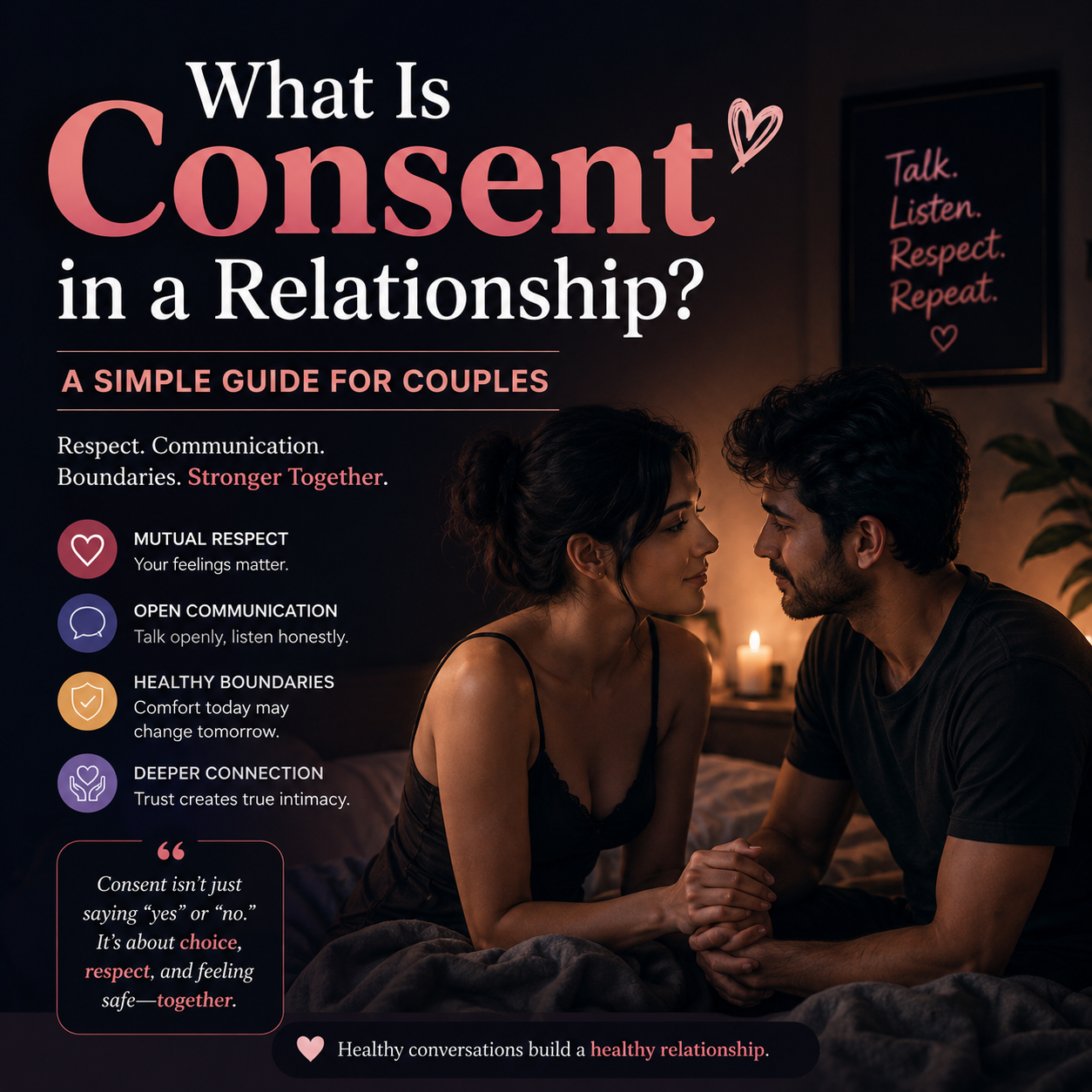
Relationships thrive on many things—love, attraction, trust, communication, and shared experiences. Yet there is one element that quietly supports all of them, especially when it comes to intimacy: Consent.
Many people hear the word consent and immediately think about legal definitions or a simple "yes" or "no." While those are important, consent in a healthy relationship is much more than a single moment or a checkbox. It is an ongoing conversation built on respect, emotional safety, curiosity, and genuine care for your partner's comfort.
This guide explores what consent really means, why it matters in everyday relationships, common misconceptions, practical ways to communicate, and how honest conversations can strengthen compatibility between partners.
Consent Is More Than Saying "Yes"
Imagine this situation.
Sonya and Ron have been dating for nearly two years. One evening, Ron suggests trying something new during intimacy. Sonya smiles politely but doesn't say much. Ron assumes her silence means she's comfortable, while Sonya feels uncertain but doesn't want to disappoint him.
Neither person intended harm. Ron believed everything was fine because there wasn't a clear "no." Sonya assumed saying nothing would avoid an awkward conversation.
This is where many couples misunderstand consent. Consent isn't simply the absence of refusal. It is the presence of enthusiasm, understanding, and freedom to choose.
Healthy consent means both partners feel comfortable expressing:
- Yes.
- No.
- Maybe.
- Not today.
- Can we slow down?
- I'd like to try, but only if...
- I'm curious but need more information first.
The healthiest relationships make space for every one of those answers.
True consent also changes over time. Something that felt exciting six months ago may not feel comfortable today. Likewise, someone who wasn't ready before may become interested later.
Our preferences evolve because people evolve. Stress, health, emotions, confidence, life experiences, pregnancy, medication, trauma, work pressure, and countless other factors influence comfort levels.
A loving partner understands that changing your mind doesn't mean you're rejecting them—it simply means you're listening to yourself.
Key Insight
Consent isn't a one-time agreement. It's an ongoing conversation where both people feel equally free to say yes, no, or maybe without fear of judgment.
Why Consent Creates Stronger Relationships.
Some people worry that talking about consent makes intimacy feel formal or awkward.
Interestingly, psychology suggests the opposite. Human beings naturally relax when they feel emotionally safe. When someone knows their boundaries will be respected regardless of the answer, their brain shifts away from protection and toward connection.
Think about friendships. You're more open with friends who never pressure you than with people who constantly push your limits. Romantic relationships work similarly.
- ◉ Respect creates emotional safety.
- ◉ Emotional safety creates trust.
- ◉ Trust creates vulnerability.
- ◉ Vulnerability creates deeper intimacy.
Rather than interrupting passion, consent often becomes part of the attraction itself. Imagine hearing your partner ask:
"Are you comfortable with this?"
"Would you enjoy trying something new?"
"How are you feeling?"
These questions communicate something powerful: Your feelings matter as much as mine.
That message strengthens relationships far beyond physical intimacy.
Over time, couples who regularly check in with one another often develop greater confidence because neither person has to guess what the other wants.
- There is less anxiety.
Less pressure.
Fewer misunderstandings.
More honesty.
And honesty is one of the strongest predictors of long-term relationship satisfaction.
Key Insight
Respect doesn't reduce attraction. For many couples, feeling emotionally safe makes attraction even stronger.
The Most Common Myths About Consent
Misunderstandings about consent often come from movies, social media, or outdated beliefs about relationships. Let's explore some of the most common myths.
Myth 1: "We've been together for years, so consent isn't necessary."
Long-term relationships don't remove the need for consent. Every intimate experience deserves mutual willingness. Being married or committed doesn't eliminate personal boundaries.
Myth 2: "If they don't say no, they're okay with it."
Silence isn't always agreement. Sometimes people stay quiet because they're nervous, unsure, tired, embarrassed, or afraid of disappointing their partner. Clear communication is always healthier than assumptions.
Myth 3: "Asking ruins the mood."
Many couples discover that asking actually builds anticipation. Simple questions can feel caring rather than clinical. Consent conversations don't have to sound robotic. They can be playful, affectionate, and natural.
Myth 4: "Changing your mind is unfair."
Everyone has the right to change their mind. Comfort can change in seconds. Respecting that change builds trust rather than resentment.
Myth 5: "If my partner says no, it means they don't love me."
This is one of the most damaging myths. A boundary is rarely a rejection of the relationship. More often, it's simply honest communication about the present moment.
Partners who separate rejection from boundaries usually experience healthier emotional connections.
Reflection
Which of these myths have you encountered in your own life, relationships, or even popular media?
How Couples Can Talk About Consent Without Making It Awkward
Communication about intimacy doesn't need to happen only during intimate moments. In fact, many relationship experts recommend discussing preferences during relaxed conversations
Imagine sitting together after dinner or while taking a walk.
Instead of saying:
"Would you do this tonight?"
Try asking:
"Is there anything you've always been curious about?"
Questions like these invite exploration without pressure. The goal isn't convincing your partner. The goal is understanding them.
Another helpful approach is using curiosity instead of assumptions.
Instead of saying:
"You'll probably like this."
Try asking:
"What do you think about this idea?"
The difference is subtle but important. One assumes. The other invites conversation.
Many couples also discover that discussing boundaries makes future conversations easier. When both partners know they can honestly express discomfort, there is far less anxiety during intimate moments.
Some conversations may even end with: "Maybe someday." And that's perfectly okay.
Compatibility isn't measured by how often both people immediately agree. It's measured by whether both people feel respected throughout the conversation.
Key Insight
Healthy conversations focus less on convincing and more on understanding each other.
Everyday Examples of Healthy Consent
Consent appears in many small moments—not only during physical intimacy.
For example:
- ◉ A partner asks before sharing private photos.
- ◉ Someone checks whether their partner wants affection after a stressful day.
- ◉ A couple discusses whether they're comfortable trying something they've seen online.
- ◉ One partner notices hesitation and immediately pauses to ask if everything feels okay.
None of these situations require dramatic conversations. They simply require awareness.
Healthy couples often develop small habits:
- ◉ Asking instead of assuming.
- ◉ Listening without interrupting.
- ◉ Accepting "no" gracefully.
- ◉ Appreciating honesty.
- ◉ Revisiting conversations as feelings change.
These habits gradually become part of the relationship's culture. Over months and years, that culture creates emotional security. And emotional security allows both people to be more authentic.
Key Insight
Healthy consent often appears in ordinary conversations long before intimate moments begin.
Why Honest Conversations Matter More Than Perfect Agreement
Some couples worry after discovering different preferences. They wonder whether disagreement means they're incompatible
Usually, it doesn't. No relationship is built on complete agreement. Successful relationships are built on successful communication.
Imagine discovering that your partner is curious about something you've never considered. You don't have to immediately agree. You don't even have to decide right away. Simply having an open, respectful discussion already strengthens trust.
Likewise, discovering shared interests can increase confidence because both partners know those interests developed through honesty rather than assumptions.
That's why conversations about boundaries should never feel like tests. They're opportunities to learn about each other. Relationships grow through understanding—not guessing. Every honest conversation creates a clearer picture of who your partner truly is. And being known is one of the deepest forms of intimacy.
Reflection
When was the last time you asked your partner what makes them feel most comfortable rather than assuming you already knew?
Understanding Each Other Better with mykfsapp
Talking openly about boundaries, interests, comfort levels, and expectations isn't always easy. Sometimes couples simply don't know where to begin.
The mykfsapp Compatibility Assessment is designed to make those conversations easier.
Instead of guessing what your partner might think, each person answers privately at their own pace. Once both partners complete the assessment using the same Couple Code, the app compares responses and highlights areas of compatibility, shared interests, and topics that may benefit from further conversation.
The goal isn't to judge anyone or define what's "normal." It's to encourage honest communication in a respectful, pressure-free environment.
Because in the end, the strongest relationships aren't built on assumptions. They're built on understanding.
Final Thoughts
Consent isn't a rule that exists outside relationships.
- ◉ It is one of the foundations that helps relationships thrive.
- ◉ It creates emotional safety.
- ◉ It encourages honest communication.
- ◉ It builds trust.
- ◉ It allows both partners to express themselves without fear of pressure or judgment.
Whether you're in a new relationship or have shared years together, taking time to understand each other's boundaries is never a sign that something is wrong.
It's a sign that your relationship is worth protecting. The next meaningful conversation with your partner doesn't have to start with a difficult question.