
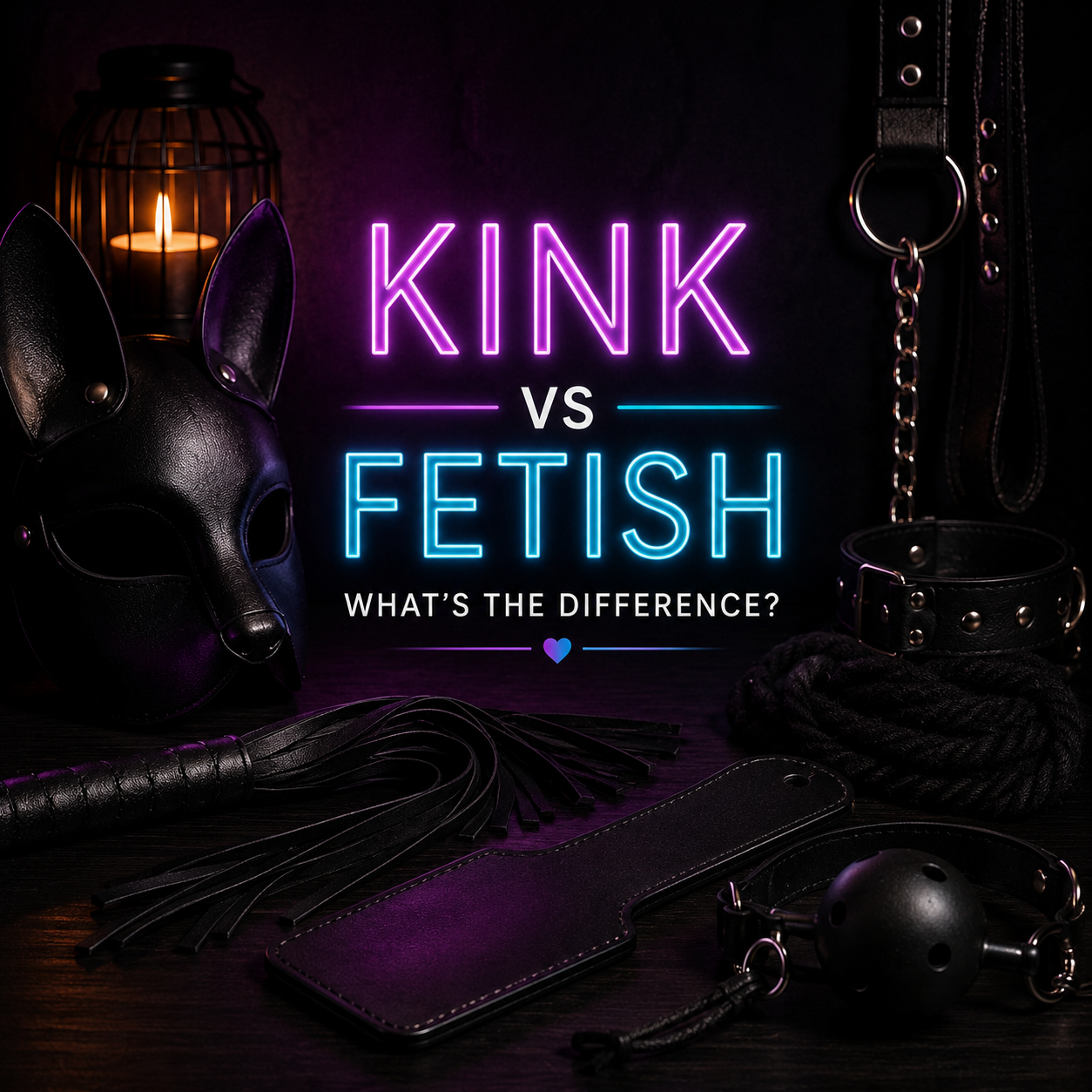
If you've ever searched for information about intimacy or relationships, you've probably come across the words kink and fetish. They're often used interchangeably in conversations, movies, and even online articles, making it seem as though they mean exactly the same thing.
They don't.
Understanding the difference isn't about labeling yourself or your partner. It's about understanding how different people experience attraction and desire. When couples know what these terms actually mean, conversations become less awkward, misunderstandings become less common, and discussing personal preferences feels much more comfortable.
The truth is that human sexuality exists on a broad spectrum. People enjoy different things for different reasons, and there's no single "normal" way to experience attraction. Knowing the difference between a kink and a fetish simply helps us communicate more clearly.
What Is a Kink?
A kink is a sexual interest or activity that someone enjoys because it adds excitement, variety, or emotional meaning to intimacy. It's usually something outside what society considers conventional, but it isn't essential for enjoying a satisfying sexual relationship.
Think of it as adding a new recipe to your favorite meal.
You still enjoy the meal without it, but trying something different can make the experience more enjoyable.
Imagine your partner says,
"I've always wondered what roleplay would be like. Would you ever want to try it?"
They're not saying their relationship is incomplete without roleplay. They're simply expressing curiosity about something they think might be enjoyable.
If both partners are interested, they might experiment with it. If they decide it's not for them, their relationship continues just as before
That's how many kinks work.
People may enjoy things like roleplay, blindfolds, light bondage, dirty talk, costumes, massage, or other forms of consensual exploration. For some, these activities add novelty or excitement. For others, they create opportunities for trust, vulnerability, or playfulness.
What's important is that these experiences enhance intimacy rather than define it.
People can have one kink, several kinks, or none at all. Preferences may even change over time as relationships grow and people become more comfortable exploring together.
Key Insight
A kink is generally an interest that adds something enjoyable to intimacy, but it isn't the foundation of someone's sexual attraction.
What Is a Fetish?
A fetish is different because the attraction itself plays a much larger role in a person's sexual experience.
Instead of simply enjoying a particular activity, someone with a fetish experiences a strong and recurring sexual attraction toward a specific object, body part, material, or situation.
For example, imagine someone who has been strongly attracted to leather since their teenage years.
It's not simply that leather clothing looks attractive. The material itself has consistently been part of what they find sexually exciting.
When they tell their partner about it, they aren't suggesting a new activity out of curiosity. They're sharing something that has been a meaningful part of their attraction for many years.
That doesn't mean every fetish is overwhelming or impossible to live without. Experiences vary from person to person. Some people experience their fetish as a major part of their sexuality, while others simply recognize it as one consistent aspect of what they enjoy.
The important distinction is that the attraction is usually much deeper than a casual preference.
Researchers don't fully understand why fetishes develop. They may be influenced by personal experiences, emotional associations, personality, or factors that aren't completely understood. For many people, there isn't a single moment when it began—they simply remember always feeling that way.
Key Insight
A fetish is generally a deeper and more consistent pattern of sexual attraction than a typical preference or curiosity.
Kink vs Fetish: What's the Real Difference?
The easiest way to understand the difference is to think about how important the interest is a person's experience of attraction.
A kink is often something a person enjoys exploring.
A fetish is usually something that plays a much more significant role in their sexual attraction.
Here are a few simple comparisons:
Kink
- Usually a preference or interest
- Often explored out of curiosity
- Adds excitement or variety
- May change over time
Fetish
- Usually a deeper pattern of attraction
- Often develops over many years
- Plays a larger role in attraction
- Often remains relatively consistent
Of course, human sexuality doesn't fit neatly into boxes. Some people identify strongly with these terms. Others don't identify with either label at all. Many people fall somewhere in between. That's completely normal.
Rather than trying to decide which label fits perfectly, it's often more helpful to understand what the experience means to the individual.
Why Does the Difference Matter in Relationships?
Imagine your partner says,
"There's something I'd like to tell you about what I find attractive."
Without understanding the difference between a kink and a fetish, it's easy to jump to conclusions.
- You might assume they're unhappy with your relationship.
- You might worry they're asking you to completely change your intimate life.
- Or you might feel pressured to respond immediately.
In reality, none of those assumptions may be true. They could simply be sharing a curiosity they'd like to explore together. Or they could be trusting you with something that's been part of their sexuality for many years.
Those are very different conversations. That's why understanding the language matters. When couples replace assumptions with curiosity, conversations become much healthier.
Instead of asking,
"Why would you want that?"
try asking,
"Can you help me understand what it means to you?"
That small shift changes the conversation from judgment to understanding. It also creates emotional safety—the feeling that both partners can talk honestly without fear of being criticized or embarrassed.
Not every couple will share the same interests. And they don't have to. Healthy relationships aren't built on having identical preferences. They're built on respecting boundaries, listening carefully, and making decisions together.
Sometimes you'll both be excited to try something new. Sometimes one person won't be interested. Both outcomes are perfectly healthy as long as they're based on honest communication and mutual respect.
Key Insight
The biggest challenge isn't having different preferences—it's making assumptions instead of having conversations.
Labels Matter Less Than Communication
Many people spend a lot of time wondering,
"Do I have a kink or a fetish?"
In many cases, that's not the most important question. A better question is,
"Can I talk openly with my partner about what I enjoy?"
Labels can help us understand ourselves, but they shouldn't become barriers to communication. Every relationship is unique. Some couples enjoy trying new experiences together. Others are happiest keeping things familiar. Neither approach is better than the other.
What matters is that both people feel respected, heard, and free to express themselves without shame. If a conversation reveals differences, those differences don't automatically mean the relationship is incompatible.
They simply become another topic to understand together. The strongest relationships aren't the ones where partners agree on everything. They're the ones where both people feel safe being honest.
Final Thoughts
The terms kink and fetish are often confused, but understanding the difference can make conversations about intimacy much easier.
A kink is generally an interest that adds excitement or variety to intimacy.
A fetish is usually a deeper and more consistent pattern of attraction.
Neither term is inherently good or bad, and neither determines the success of a relationship. What truly matters is how couples communicate about their preferences.
When partners approach these conversations with curiosity instead of judgment, they're far more likely to build trust, strengthen emotional intimacy, and better understand each other's needs.
The mykfsapp Compatibility Assessment is designed to support exactly those conversations. By allowing partners to privately explore their preferences and compare responses across hundreds of relationship and intimacy topics, it helps couples discover where they naturally align, where they differ, and how honest communication can bring them closer.
Because lasting compatibility isn't about sharing every preference. It's about creating a relationship where both people feel comfortable talking about them.